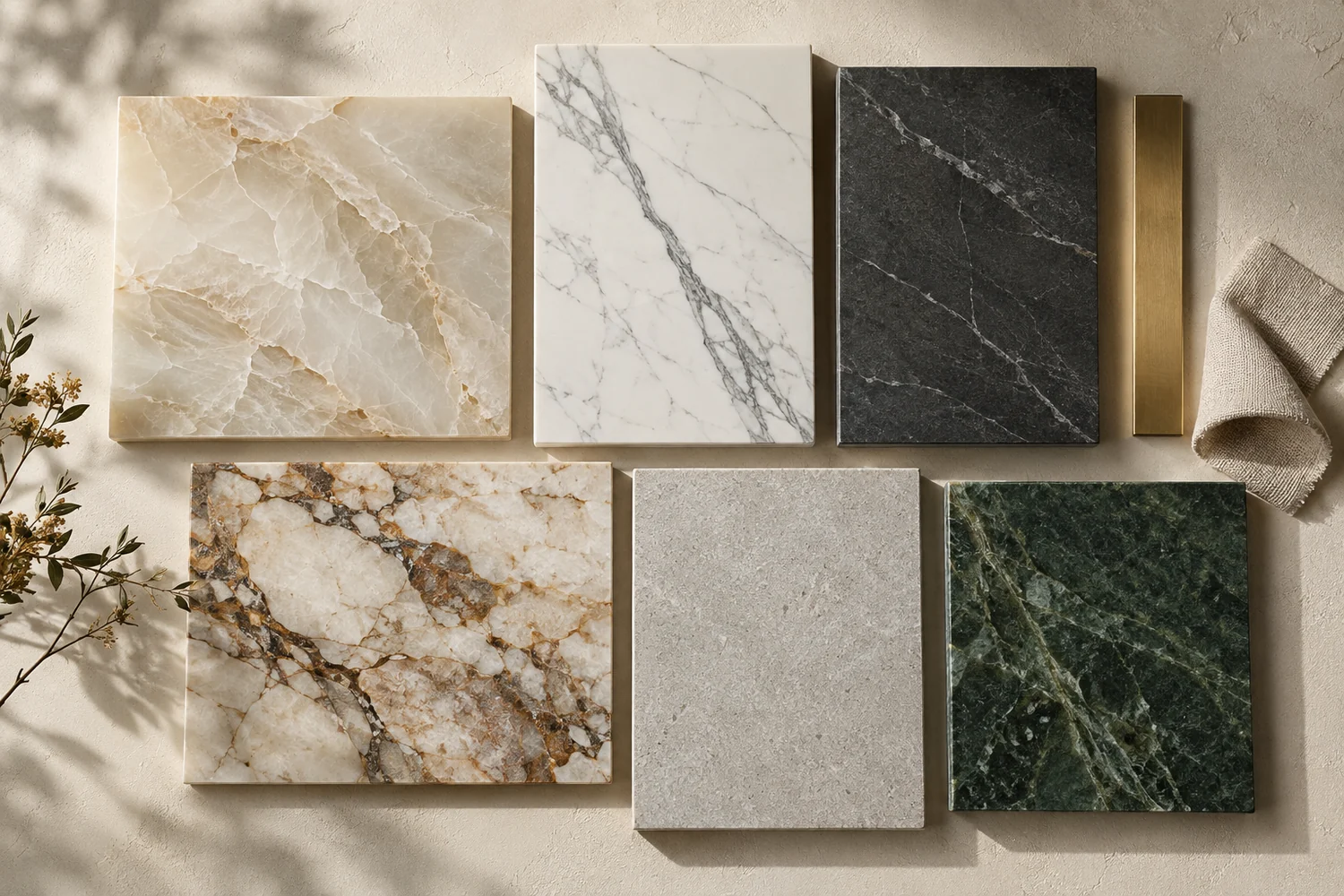
Choose a surface for your actual kitchen
A benchtop has to work with your cabinets, your budget and your daily habits. Start by describing how the space is used: regular family cooking, entertaining, occasional preparation or a busy commercial setting. Then decide which matters most to you: a particular colour, an individual slab pattern, a quiet finish or a specific care routine.
The material family is a starting point. Your quote and installation should be based on a named product, its current specifications and the details of your design. Two surfaces that look similar in a small sample can have different fabrication requirements.
Compare the choices without relying on labels
Explore the project details for natural stone, porcelain benchtops and zero-silica products as you build your shortlist.
| Material choice | Design questions | What to confirm |
|---|---|---|
| Natural stone | Which actual slab and finish suit the room? | Stone-specific care, sealing advice and the proposed slab layout. |
| Porcelain | How will the selected pattern look at edges and waterfalls? | Product thickness, edge treatment and installation specifications. |
| Zero-silica product | Which brand, colour and finish are you comparing? | Current product documentation, intended use and care instructions. |
A colour name or the description “stone-look” doesn't tell you everything needed to fabricate a benchtop. Keep the supplier's product code with your sample so the surface you choose can be identified accurately.
Look beyond the small sample
Take samples into the kitchen and view them alongside cabinet doors, flooring and splashback choices. Look in daylight and under the lighting you'll use at night. A warm white can feel different beside a cool cabinet finish; a busy pattern can compete with other strong textures in the room.
For natural stone, discuss selection of the actual slab. For any strongly patterned surface, ask how the pattern will be positioned across the island, adjoining runs and waterfalls. A small sample helps with colour, but it won't show the complete arrangement of larger veins or features.
Discuss edges, joins and thickness early
The visible thickness is part of the design brief. Specify whether you want a simple edge or a thicker built-up appearance, and ask how that detail will meet corners and waterfall panels. Don't assume a printed surface will look the same on a cut edge as it does across the top.
Slab dimensions, access and the kitchen layout can influence where joins are proposed. Ask for the intended join locations before fabrication is finalised. A clear discussion of these details is more useful than choosing a material with an expectation of an invisible or completely join-free installation.
Read the care instructions before buying
Ask for the selected manufacturer's cleaning guide and warranty terms. Check the recommended daily cleaner, advice on spills, hot cookware and chopping, and any products to avoid. Keep those instructions with your project records rather than relying on advice for a different surface.
Sealing advice for natural stone should be specific to the stone and treatment selected. The Natural Stone Institute's sealing guidance explains that sealing decisions vary. For a branded manufactured surface, use that manufacturer's documentation; Cosentino's Australian technical library, for example, provides product-specific documents.
Get quotes against the same brief
Give each quote the same material, measurements, edge detail, cutouts and removal requirements. Ask what is included in supply, fabrication, delivery and installation. A lower total may describe a different scope rather than a directly comparable project.
Explore our material options or send your preferred product and plans. If you're still collecting dimensions, our measuring guide shows what helps.